
By Oluwafunke Allen
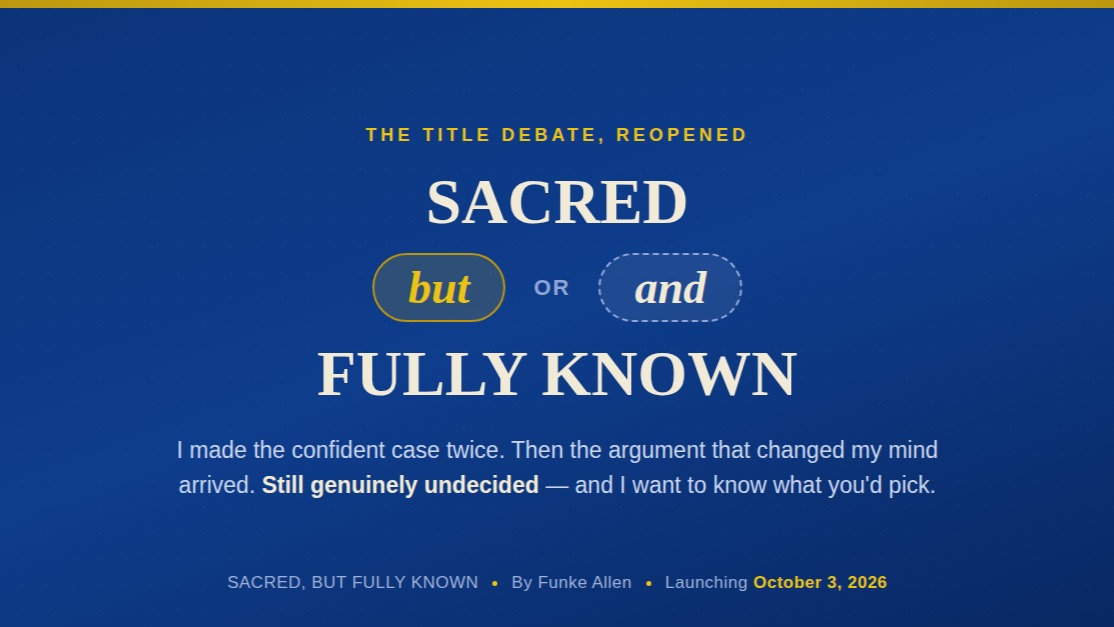
I’ve now made the confident case for keeping “but” in this title twice on this blog. I stand by both posts the reasoning in them was sound at the time, and I don’t think either was dishonest. But I owe you an update, because a third round of analysis landed on my desk since then, and this time it didn’t just add nuance. It genuinely moved me toward the opposite conclusion. I’m not going to pretend that didn’t happen, and I’m not going to quietly resolve it off-screen and hand you a tidy final answer either. I’d rather show you the actual state of my thinking and ask what you’d do.
Why I’m not just picking a side and moving on
Here’s my honest problem: the case for “and” turns out to rest on one argument I underweighted badly the first two times that “but,” in the specific technical sense NLP practitioners use, functions as a negation operator. Put plainly, “X, but Y” doesn’t just note a contrast between X and Y. It quietly instructs the listener to discount X and treat Y as the real point. If that’s true of my title, “Sacred, but Fully Known” isn’t neutrally holding two truths in tension. It’s covertly telling your nervous system that “sacred” is the thing being conceded, and “fully known” is what actually matters which is close to the exact opposite of what this book spends 190 pages arguing. That’s not a small stylistic quibble. That’s a mechanism working against my own thesis, on the cover, before anyone’s read a single page.
The argument that made me reconsider my own reconsideration
Here’s the part I find genuinely uncomfortable to admit: I’d previously credited “but” with doing something valuable meeting the reader in the fear they already carry around the word “sacred,” before leading them somewhere freer. That’s a real technique. I use it constantly in counselling, and I teach it in the book itself. But pacing a reader’s fear before leading them somewhere new requires time sentences, paragraphs, the sustained attention of someone who’s already chosen to stay with you. A four-word title has none of that room. My own Foreword does this pacing beautifully, across several paragraphs, before it ever offers the reader anywhere new to go. The title can’t do in four words what my own book already does properly, one page later. I was crediting the cover with work that actually belongs to and already lives in page one.
What I’m not conceding
I want to be fair to my own earlier reasoning too, because not everything in the case for “and” held up equally well. One argument leaned on ancient Hebrew grammar to justify a 2026 English marketing title, which is a lovely echo but not actually a linguistic constraint on my choice. Another leaned on the psychology of primacy and recency effects real phenomena, but ones measured on long lists, not two-word phrases, and I think that argument gets retired rather than resolved. Strong packaging and strong argument aren’t always the same thing, and I want to hold onto that distinction even while admitting the parts that genuinely landed.
Where that leaves me, honestly
Genuinely undecided, and I don’t think that’s a failure of process I think it’s what taking a real argument seriously actually looks like sometimes. James 1:5 says if any of us lacks wisdom, we should ask God, who gives generously without finding fault. I’ve been asking. I haven’t gotten a lightning-bolt answer yet, and I suspect this one gets settled the ordinary way: more sitting with it, more counsel, more time.
What I’d actually like from you
Tell me honestly: if you saw this book on a shelf with no other context, cold, which title would make you pick it up “Sacred, but Fully Known” or “Sacred and Fully Known”? I’m not asking rhetorically. I’m asking because you’re closer to the actual reader this analysis keeps trying to model than any of the frameworks are, and I’d rather hear it from you directly than keep guessing on your behalf.
The line I want you to keep
Being willing to be wrong about something you’ve already defended twice, in public, is uncomfortable and I think it’s also exactly what this whole book is asking of its readers on a much bigger subject than a title. I’m trying to practice what I’m asking of you.
Over the next few posts, I’ll walk through the specific arguments in more depth starting with what “but” actually does to a sentence, according to the people who study exactly that for a living.
Sacred, but Fully Known launches October 3rd. Subscribe below to find out which one wins.
— Funke
Sacred, but Fully Known: A Faith-Rooted Companion to Intimacy in Marriage launches October 3rd, 2026. Subscribe above to follow the story, and to be first in line on launch day.
