
By Oluwafunke Allen
Here’s a sentence for you: “She’s brilliant, but she’s difficult to work with.” Now notice something you almost certainly filed that as a warning about her being difficult, not as praise for her brilliance, even though both halves were stated with equal grammatical weight. That’s not your imagination. That’s “but” doing exactly what it’s built to do, and it turns out to matter a great deal more for a four-word book title than I originally gave it credit for.
The technical term, and why it isn’t just a fancy label
In Neuro-Linguistic Programming, this function has an actual name: a negation operator. The idea, drawn from what’s called the Milton Model patterns of language originally studied in the work of hypnotherapist Milton Erickson is that “X, but Y” doesn’t hold X and Y as equally weighted. It functionally backgrounds X and foregrounds Y as the operative claim. The listener’s attention quietly slides past the first half and lands on the second, treating it as the “real” content the sentence was building toward. This isn’t a metaphor or a loose literary observation. It’s documented, repeatable language behaviour.
Why this is a genuine problem for my own title
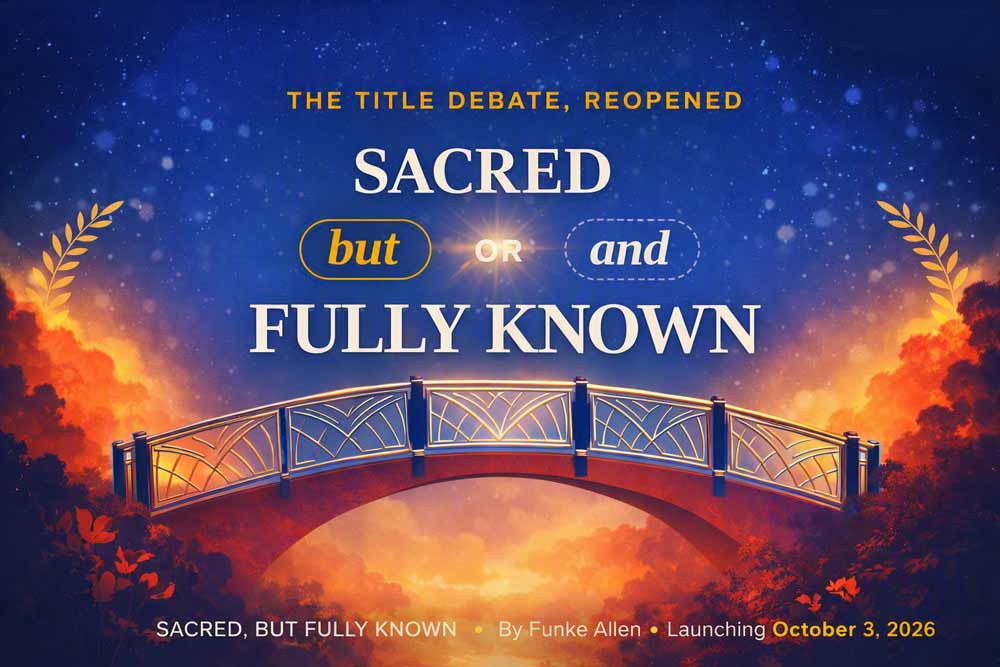
Sit with what that means for “Sacred, but Fully Known.” If the negation-operator function holds here the way it holds in ordinary speech, the title isn’t neutrally presenting two truths side by side. It’s quietly instructing a reader’s nervous system to discount “sacred” as the lesser, conceded truth, and to treat “fully known” as the thing that actually matters. Read that against my own book’s central argument that neither sacredness nor being fully known displaces the other, that they were always meant to coexist without either one losing ground and you can see the problem immediately. My title may be doing the opposite of what my book spends its length trying to prove, on a purely mechanical, linguistic level, before a single page is turned.
Why I didn’t catch this the first two times
I’d previously weighed “but” almost entirely as a piece of emotional pacing a word that names tension before resolving it, the same technique good pastoral counselling uses constantly. That’s a real function “but” can serve. What I hadn’t weighted properly is that it’s doing two jobs at once: naming tension, yes, but also quietly subordinating whatever comes before it. I was crediting the first job and ignoring the second, and the second job turns out to be the one working against my own thesis.
Proverbs 18:21 says death and life are in the power of the tongue a verse usually applied to how we speak to other people, but it applies with unsettling precision to how a single conjunction can quietly shape what a reader believes before they’ve consciously registered a single argument. Words carry mechanism, not just meaning. This is a case where the mechanism was working somewhere I hadn’t been looking.
What this doesn’t settle, though
Here’s where I want to be careful rather than simply reverse my position outright: identifying a real cost to “but” is not the same as proving “and” wins outright. The pacing benefit I’d credited to “but” meeting a reader in their fear before leading them somewhere freer is a real technique, and real techniques don’t stop being valuable just because I placed them in the wrong location. The question this raises isn’t only “does ‘but’ subordinate ‘sacred’.” It’s also “where does the pacing this book needs actually belong, if not on the cover.” I think I know the answer to that second question the Foreword’s already doing that work, patiently, across several paragraphs, in a way four words never could. But the negation-operator problem is real regardless, and it’s the strongest single argument against “but” that’s crossed my desk yet.
What this looks like practically, beyond just my own title
If you’re a communicator of any kind a parent explaining something hard to a child, a leader giving feedback, anyone choosing words that carry weight it’s worth noticing your own “buts.” The thing you say before it is the thing you’re quietly telling the listener to let go of. Sometimes that’s exactly what you want. Often, without meaning to, it’s the opposite of what you meant to emphazise.
The line I want you to keep
A single conjunction can carry more instruction than either half of the sentence it connects. I built an entire book title around one without fully accounting for what it was doing beneath the surface, and I’m genuinely glad someone caught it before the cover was final rather than after.
I still haven’t settled where I’ve landed on my own title more on that in the next post, where the debate gets even more interesting.
Sacred, but Fully Known launches October 3rd. Subscribe below to find out which one wins.
— Funke
Sacred, but Fully Known: A Faith-Rooted Companion to Intimacy in Marriage launches October 3rd, 2026. Subscribe above to follow the story, and to be first in line on launch day.
