
By Oluwafunke Allen
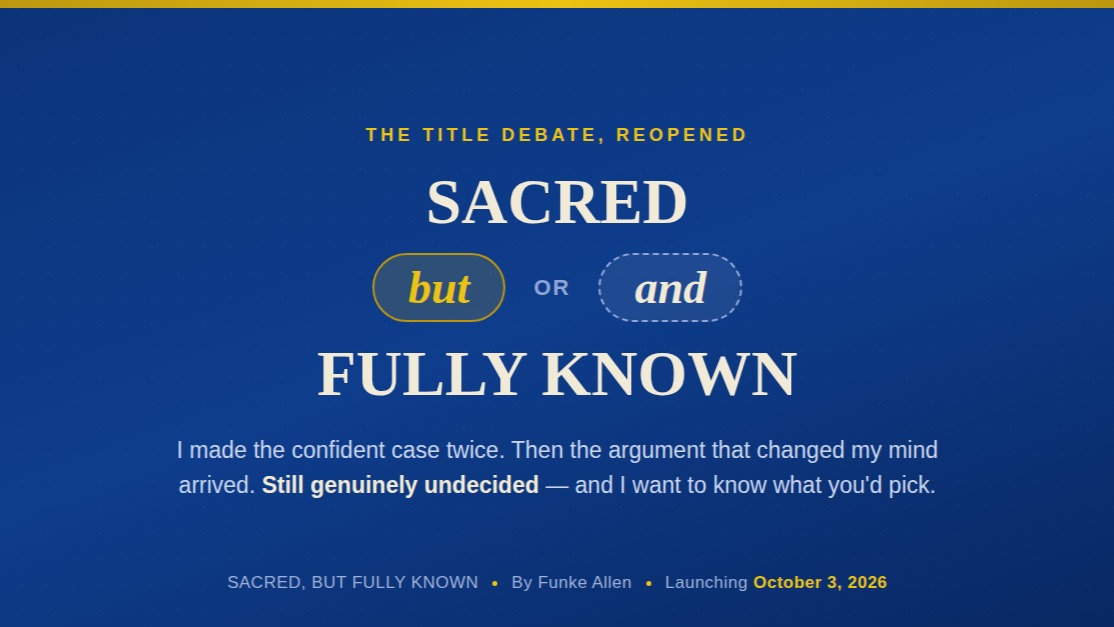
While the “and versus but” question keeps me genuinely undecided, a smaller question attached to it turned out to have a much clearer answer, once I got past the fanciest-sounding argument for it. Should the title lead with “sacred” or with “fully known”? I want to walk you through why I initially found one explanation persuasive, why it doesn’t actually hold up, and what the real reason turned out to be.
The argument that sounded rigorous and wasn’t
The first case I read for reversing the order “Fully Known” first, “Sacred” second leaned on something called the recency effect: the psychological finding that the last item in a sequence tends to be remembered best. It sounds properly scientific, and it’s a real, well-documented phenomenon. Here’s the problem: recency and primacy effects come from research on lists, typically ten items or more, where researchers are specifically studying why the middle of a long list gets forgotten while the beginning and end survive. Apply that framework to a two-word phrase and the whole mechanism collapses, because there’s no middle to forget. Nothing in a two-word title can experience the “middle of the list” decay the effect actually describes. The reasoning borrowed real psychology vocabulary and applied it somewhere the underlying phenomenon doesn’t actually operate. It sounded rigorous. It wasn’t testable at that scale, and I think it should be retired rather than relied on.
The argument that actually held up
Here’s the plainer, less flashy reason “Sacred” belongs first, and I trust it more precisely because it doesn’t dress itself up as a psychology citation: it’s simply the better sentence to read aloud. “Sacred and Fully Known” opens on the weightier, more abstract word and closes on the warmer, more human one. Say the reverse out loud “Fully Known and Sacred” and notice it front-loads the emotional hook but ends on the colder word, which is a weaker note for any title to land on. Titles get read aloud more than we account for in conversation, in recommendations, in a bookstore browse and the one that closes on warmth simply performs better in the mouth and in the ear.
Why this order also happens to be the correct theological sequence
This is where craft and content turned out to agree, and I find that satisfying rather than coincidental. My own book’s chapters move in exactly this order: identity and design first who God made us to be, made in His image, Genesis 1:27’s declaration that this was very good and only afterward does the book arrive at yada, the Hebrew concept of being fully known that Genesis 4:1 introduces. Union follows covenant. Being known follows being made sacred in the first place. A title that put “Fully Known” first would be asking the reader to arrive at the destination before the book has walked them through the design that makes that destination make sense.
Why I’m telling you about the argument that failed, not just the one that worked
I think this matters beyond just my title. It’s tempting, when you’re trying to make a confident decision, to reach for whatever sounds most authoritative a study, a technical term, a framework with real credentials attached to it elsewhere. Sometimes that reach is earned. Sometimes, like the recency-effect argument here, it’s borrowed prestige applied somewhere it doesn’t actually fit, and the honest, simpler reason sitting right next to it gets overlooked because it doesn’t come with a citation attached. I’d rather show you both, and let you see why one survived scrutiny and the other didn’t, than just hand you my conclusion and ask you to trust the process happened correctly behind the scenes.
The line I want you to keep
Not every argument that sounds like research actually is research, and the simplest true reason is sometimes sturdier than the most impressive-sounding one standing next to it. “Sacred” stays first not because of a psychology term borrowed from list-memory studies, but because it’s the truer sentence, read aloud, and the truer sequence, chapter by chapter.
If you have thoughts on the bigger question still sitting open “and” or “but” I’d genuinely like to hear them; see the previous two posts for the full case on both sides.
Sacred, but Fully Known launches October 3rd. Subscribe below to find out which one wins.
— Funke
Sacred, but Fully Known: A Faith-Rooted Companion to Intimacy in Marriage launches October 3rd, 2026. Subscribe above to follow the story, and to be first in line on launch day.
