
By Oluwafunke Allen
Before I tell you the last thing I learned from this whole title saga, I want to name something about the process itself, because I think it’s more useful to you than the title debate is on its own. The analysis that made me reconsider “but” arrived formatted like a panel of independent experts weighing in from different disciplines theology, pastoral care, linguistics each one stating a position, each one getting challenged, a verdict reached by convergence. It read as though multiple qualified people had independently reached the same conclusion. There was no panel. It was one analysis, dressed in panel clothing. And I want to be honest that it worked on me, at least a little, before I slowed down enough to separate the format from the substance.
Why the format matters, even when the content is genuinely good
I want to be fair here: some of the actual arguments inside that analysis were strong, strong enough to move my own position. But the packaging the sense of multiple independent voices converging was doing real persuasive work of its own, separate from whether any individual argument held up. That’s worth naming plainly, because it’s a pattern that shows up everywhere, not just in title analyses. A claim presented as “several experts agree” carries more weight in our minds than the identical claim presented as one person’s opinion, even when the underlying reasoning is exactly the same either way. The format itself is a kind of argument, and it’s one we should learn to notice and set aside before judging the actual content underneath it.
How I actually sorted the good arguments from the impressive-sounding ones
Once I set the panel format aside, I went through each individual claim and asked one plain question: does this argument survive being restated in the plainest possible language, with the impressive vocabulary removed? The negation-operator point survived that test easily “but tells you to discount what came before it” is a real, checkable claim about how language works, plain language and all. The recency-effect point did not survive once I asked what the effect actually measures and where, the argument turned out to be borrowing scientific-sounding vocabulary without the underlying phenomenon actually applying at the scale in question. Same test, two very different outcomes, and the test had nothing to do with how confidently either argument had been presented.
1 Thessalonians 5:21 tells us to test everything and hold fast to what is good — not to trust everything that sounds credible, and not to dismiss everything that challenges what we already believed either. Testing is the actual instruction. Neither reflexive belief nor reflexive scepticism is what’s being asked of us here.
Why this matters far beyond a book title
I think about this constantly in the counselling room, actually not with academic papers, but with the confident-sounding claims a spouse sometimes brings in about what “always” works, what a marriage counsellor “always” says, what their pastor, their mother, or an article they read definitely established. Confidence and formatting are not evidence. A claim delivered with total certainty by someone citing an authority is not automatically truer than the same claim offered tentatively by someone with no credentials attached at all. The actual test is always the same: does the reasoning hold up once you strip away how it was delivered.
What this looks like practically
When something changes your mind quickly, pause and ask whether it was the argument or the presentation doing the persuading both are real, but only one of them should actually move you. Restate the claim in the plainest language you can manage, and see if it still sounds true once the impressive vocabulary is gone. And don’t let the discovery that a claim was over-packaged make you dismiss the parts of it that were genuinely sound I still think the negation-operator point is real and important, even after noticing the panel format doing some of the persuading alongside it.
The line I want you to keep
A strong argument doesn’t need a panel of invented experts to be true, and a weak one doesn’t stop being weak just because it arrives wearing one. Test the reasoning, not the packaging and once you’ve done that, you may find, as I did, that some of it was right all along.
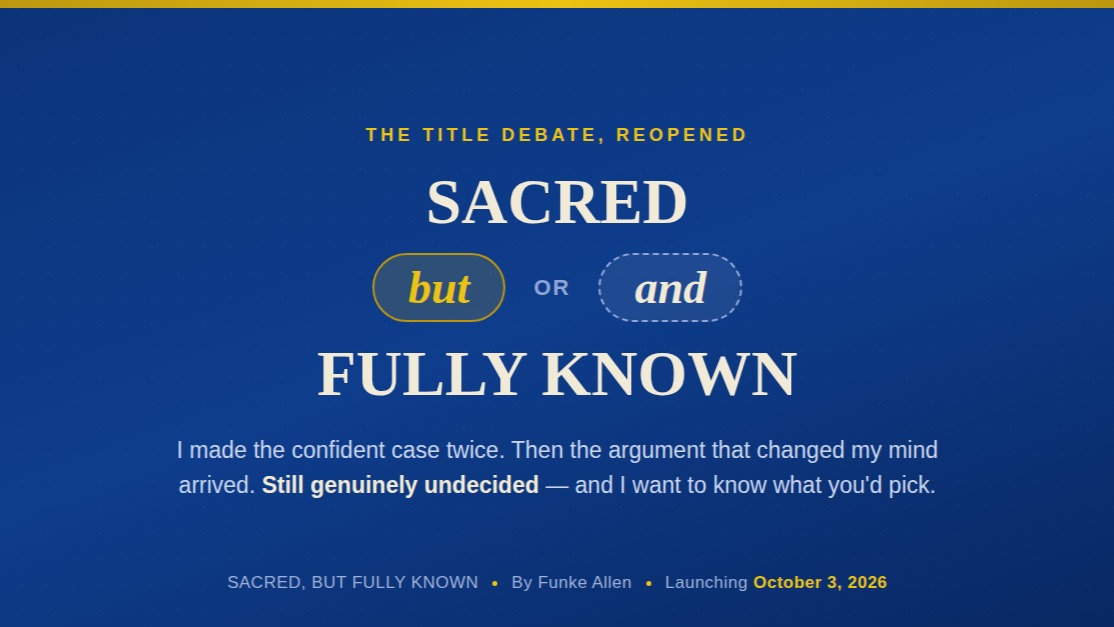
I still haven’t landed a final answer on my own title, “and” or “but” and at this point, I’m genuinely curious whether you have.
Sacred, but Fully Known launches October 3rd. Subscribe below to find out which one wins.
— Funke
Sacred, but Fully Known: A Faith-Rooted Companion to Intimacy in Marriage launches October 3rd, 2026. Subscribe above to follow the story, and to be first in line on launch day.
